
Having a pond can be a beautiful addition to your property, but understanding its size is crucial for proper maintenance and care. Did you know that calculating the gallons in your pond is essential for determining the right amounts of treatments, filters, and aquatic life it can support? This guide will walk you through the steps to accurately work out the gallons in any pond, empowering you to create a thriving aquatic environment. Whether you’re a homeowner, a landscaper, or simply an enthusiast, mastering this calculation will enhance your pond’s health and enjoyment. Dive deeper with us to ensure your pond remains a vibrant and balanced ecosystem!
Understanding the Importance of Gallon Measurement in Ponds
Understanding the volume of water in your pond is crucial for maintaining a healthy aquatic ecosystem. The ability to measure your pond’s gallon capacity accurately can help ensure that you create ideal living conditions for fish and plants alike. From determining the necessary amount of chemicals for treatments to planning for seasonal temperature changes and understanding how much filtration you need, accurate gallon measurement has far-reaching implications.
When you know the total volume of water in your pond, you can better manage water quality, prevent contamination, and create suitable habitats for various aquatic species. For example, if your pond is too shallow, it can lead to overheating in summer months, which affects fish health. Conversely, a deeper pond may cause temperature stratification that can impact oxygen levels. By grasping the importance of gallon measurement, you set yourself on the path toward effective pond management.
Additionally, precise calculations can aid in resource planning. If you’re looking to introduce new fish or flora, knowing your pond’s capacity allows for optimal stocking rates, preventing overpopulation that can lead to competition for resources and eventual die-off. Furthermore, many pond management practices, including water changes and aeration, hinge upon accurate volume measurements. This attention to detail not only enhances the aesthetic value of your pond but also promotes sustainability and longevity for your aquatic environment.
In summary, understanding how to measure your pond’s gallons accurately is not just a mathematical exercise; it’s an essential skill for every pond owner committed to fostering a thriving water feature. By keeping your pond’s volume in mind, you take the necessary steps toward achieving a balanced and vibrant aquatic ecosystem.
Basic Math Concepts for Calculating Pond Gallons
Calculating the volume of water in your pond is more than just a math task; it’s essential for ensuring a thriving aquatic environment. Understanding some basic math concepts can make this process easier and more intuitive. At its core, the measurement of gallons involves grasping the relationship between volume, dimensions, and conversions. The standard formula for calculating volume revolves around the basic geometric shapes, which you can usually simplify based on your pond’s shape.
One primary concept to keep in mind is the difference between cubic and linear measurements. While cubic measurement refers to the space inside a volume (like your pond), linear measurement deals with the dimensions of that volume – length, width, and height (or depth). In the case of a rectangular pond, for example, calculating the volume is as simple as multiplying these three dimensions together:
- Length (ft)
- Width (ft)
- Depth (ft)
The formula you’ll commonly use is:
Volume (cubic feet) = Length x Width x Depth
Once you have the volume in cubic feet, converting this to gallons is straightforward. Knowing that one cubic foot equals approximately 7.48 gallons allows you to easily translate your calculations:
- Gallons = Volume (cubic feet) x 7.48
This knowledge sets the foundation for measuring various pond shapes. For ponds that are not rectangular, you might deal with circular or irregular shapes, where you’ll need to adapt your calculations. Each shape has its unique formula for volume, making a basic understanding of geometry invaluable.
In practice, the process of measuring and calculating can become intuitive with a bit of practice. Start by gathering your tape measure and perhaps even a digital calculator to streamline the process. With these basic math concepts at your disposal, you can achieve accuracy in your pond volume calculations, leading to a healthier aquatic environment for all its inhabitants. Remember, a little attention to detail in your measurements today can make a significant impact on the wellbeing of your pond ecosystem tomorrow.
Step-by-Step Guide to Pond Volume Calculation
Calculating the volume of your pond is an essential step toward maintaining a healthy aquatic environment. Knowing how many gallons of water are present not only aids in managing water quality but also enhances fish health and plant growth. A step-by-step approach makes this process manageable, even if math isn’t your strong suit.
Begin by gathering the necessary tools: a tape measure, a notebook, and possibly a calculator for conversion. If your pond is rectangular or square, measuring is straightforward. Follow these steps:
- Measure Length and Width: Use your tape measure to find the length and width of the pond in feet. Record these measurements. If your pond has a complicated shape, consider breaking it down into smaller rectangles or circles for easier calculation later on.
- Measure Depth: This is crucial. For a simple rectangular pond, measure the maximum depth at several points and then find the average depth. Record this average, as it will be important for the volume calculation.
- Calculate Volume: Once you have your measurements, use the formula for volume:
Volume (cubic feet) = Length x Width x Average Depth
This will give you the volume in cubic feet.
- Convert to Gallons: To convert cubic feet to gallons, multiply your result by 7.48 (since there are approximately 7.48 gallons in a cubic foot):
Gallons = Volume (cubic feet) x 7.48
- Verify Measurements: If possible, double-check your measurements to ensure accuracy. Minor errors in measurement can lead to significant differences in calculated volume.
For example, if your pond measures 10 feet long, 5 feet wide, and has an average depth of 3 feet, your calculation flow would be as follows:
- Volume = 10 ft x 5 ft x 3 ft = 150 cubic feet
- Gallons = 150 cubic feet x 7.48 = 1,122 gallons
Following these steps not only helps in understanding your pond’s capacity but also prepares you for effective pond management, ensuring a vibrant ecosystem for aquatic life. Don’t rush through the calculations. Take your time, and start to enjoy the intricacies of pond maintenance. With practice, these measurements will become second nature, enhancing your gardening skills and overall enjoyment of the outdoor space.
Common Formulas for Calculating Different Pond Shapes
Calculating the volume of your pond accurately is crucial, especially when it comes to maintaining a healthy aquatic environment. Different pond shapes require specific formulas to determine their volume, which directly affects water management decisions such as filtration, plant placement, and fish stocking. Here are some common formulas tailored for a variety of pond shapes.
For rectangular or square ponds, the formula remains quite straightforward. You can calculate the volume using:
Volume (cubic feet) = Length x Width x Average Depth
This formula is effective for ponds that maintain a consistent shape across their entire surface area.
When working with circular ponds, you’ll need to adapt your approach slightly. The volume can be calculated using:
Volume (cubic feet) = π x (Radius^2) x Average Depth
Here, the radius is half the diameter of your pond. Remember that π (Pi) is approximately 3.14; for ease, you can use this simplified version in your calculations.
For ponds with more irregular shapes, it can be beneficial to break them down into smaller, more manageable sections. For instance, if your pond features both rectangular and circular components, you can calculate the volume of each section individually before summing them for the total volume.
Another common shape is the oval or elliptical pond. The formula in this case is:
Volume (cubic feet) = π x (Length/2) x (Width/2) x Average Depth
This adaptation allows you to accurately account for the non-circular shape while still using the principles of the circular formula.
Utilizing these formulas not only aids in the accurate measurement of your pond’s volume but also empowers you to create a thriving ecosystem by ensuring that all environmental factors are considered. By understanding how to calculate the different shapes, you’ll be better equipped to manage your pond effectively and respond to varying needs in terms of maintenance and habitat health.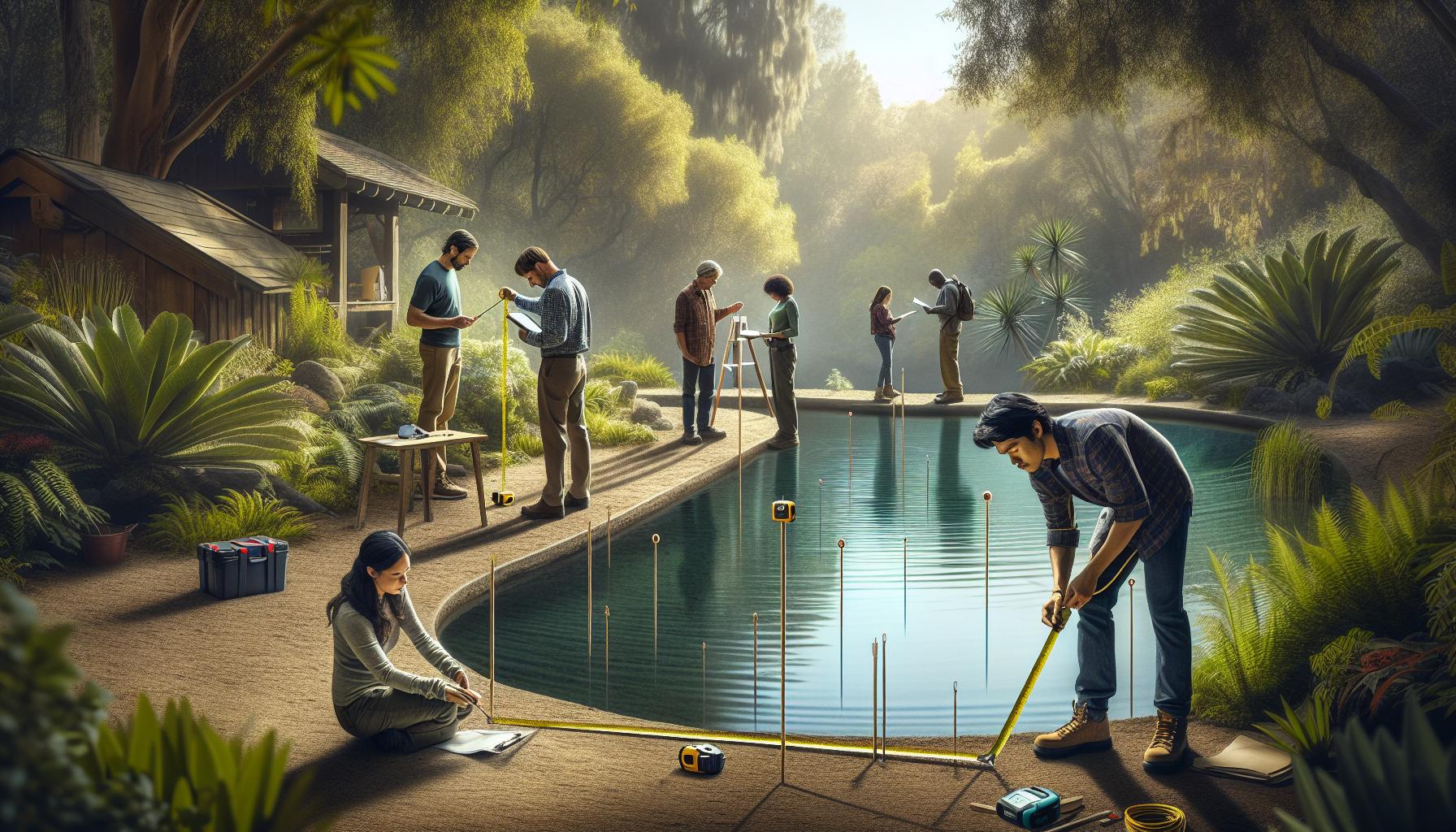
How to Measure Your Pond Dimensions Accurately
To accurately measure the dimensions of your pond, precise techniques and tools are essential. Even small discrepancies can lead to significant errors in your volume calculations, which directly impact ecosystem management. Understanding how to properly gauge the size of your pond sets the foundation for ensuring a balanced aquatic habitat.
Start by gathering basic measuring tools: a sturdy measuring tape, a notepad, and a pen. If your pond is larger or has an irregular shape, you might also want to consider using a laser distance measurer for greater accuracy. Begin measuring the length and width of the pond at the water’s edge, ensuring that you are capturing the maximum dimensions. For irregularly shaped ponds, it is effective to break the pond into sections, treating each subsection as a separate, manageable shape (like rectangles or circles). For best results, measure at the widest points to ensure your calculations reflect the true size of the pond.
Depth measurement can pose a challenge, especially if the pond varies in depth. Use a weighted rope or a depth finder to measure the average depth accurately, moving around the pond to gather multiple depth readings. Take care to note any varying depths, as it’s crucial for determining the pond’s volume effectively. If your pond has a gradual slope, it may help to establish depth markers along the edges at intervals. Finally, to simplify complex pond shapes, consider sketching the pond on paper with the dimensions noted, which can be an excellent reference when performing your calculations.
Keeping track of your measurements will not only aid in calculating your pond’s volume but will also assist in maintaining a healthy ecosystem. By ensuring every detail is noted, you can return to these measurements in the future for ongoing management and potential adjustments, helping your aquatic environment thrive.
Understanding Water Depth and Volume Relationships
Understanding the relationship between water depth and volume is crucial for anyone managing a pond. Did you know that even a small change in depth can have a significant impact on the total volume of water? This relationship is fundamental to maintaining the health of your aquatic ecosystem, supporting fish populations, and ensuring the proper balance of nutrients.
Water volume in a pond is calculated by combining the surface area with the average depth. The basic principle is straightforward: volume equals area multiplied by depth. For ponds with uniform depth, this is relatively easy. However, many ponds have varying depths, which can complicate volume calculations. In these cases, using the average depth rather than a single depth measurement becomes essential. To find the average depth, take multiple measurements at various points throughout the pond, then divide the sum of these measurements by the number of readings taken. This method helps provide a more accurate representation of the pond’s true volume.
To illustrate, consider a pond that is 100 feet long and 50 feet wide with an average depth of 4 feet. The volume can be calculated using the formula:
Volume = Length x Width x Average Depth
In this example, the calculation would look like:
| Measurement | Value (feet) |
|---|---|
| Length | 100 |
| Width | 50 |
| Average Depth | 4 |
| Total Volume | 20,000 cubic feet |
Once you have the volume in cubic feet, you can convert it to gallons (1 cubic foot = 7.48 gallons).
By understanding this vital relationship between depth and volume, pond owners can make informed decisions about pond management, including the stocking of aquatic life and the maintenance of water quality. This knowledge ensures that your pond remains a thriving habitat for fish, plants, and other wildlife, creating a balanced ecosystem that supports both beauty and biodiversity.
Practical Examples: Calculating Gallons for Various Ponds
Calculating the volume of water in a pond can be an enriching experience, especially for those who are passionate about maintaining a healthy aquatic ecosystem. To visualize how different pond shapes and sizes affect water volume, let’s explore some practical examples that demonstrate how to calculate gallons for various pond configurations.
For a simple rectangular pond, you can use the previously mentioned formula: Volume = Length x Width x Average Depth. For instance, let’s say you have a rectangular pond measuring 30 feet in length, 20 feet in width, and an average depth of 5 feet. The calculation would be:
| Measurement | Value (feet) |
|---|---|
| Length | 30 |
| Width | 20 |
| Average Depth | 5 |
| Total Volume | 3,000 cubic feet |
Now, converting this to gallons involves multiplying by 7.48 (since 1 cubic foot equals 7.48 gallons). Thus, the pond holds approximately 22,440 gallons of water.
Another example is a circular pond, which can be a bit trickier. If the pond has a diameter of 20 feet and an average depth of 4 feet, you first calculate the area of the circle using the formula Area = π x (radius²). The radius would be 10 feet (half of the diameter):
| Measurement | Value |
|---|---|
| Radius | 10 feet |
| Area | 314.16 square feet |
Now, using the area to find volume:
Volume = Area x Average Depth = 314.16 x 4 = 1,256.64 cubic feet. Converting this into gallons results in about 9,400 gallons.
Lastly, for a more irregular-shaped pond, taking multiple depth measurements and averaging them can provide an accurate volume. Suppose you measured various depths around an irregular pond and found them to average at 3 feet with surface area dimensions providing 500 square feet. The calculation would then yield a volume:
Volume = 500 x 3 = 1,500 cubic feet or roughly 11,235 gallons after conversion.
These examples show that regardless of the pond’s shape, applying fundamental math calculations can empower you to understand your pond’s water volume accurately. This knowledge not only aids in effective management but ultimately contributes to a sustainable aquatic environment.
Using Online Calculators for Quick Estimates
Harnessing technology can significantly simplify your pond volume calculations, providing an immediate solution for anyone looking to estimate their pond’s gallon capacity without diving deep into mathematical formulas. Online calculators dedicated to pond volume assessments have become valuable tools for both novice and experienced pond owners alike. These interactive resources eliminate the guesswork and provide quick, accurate solutions, allowing you to focus more on enjoying your aquatic environment rather than getting bogged down in complex calculations.
Most online calculators ask for basic inputs that can usually be measured with just a few simple steps. For rectangular ponds, enter the length, width, and average depth. Circular ponds require the diameter and average depth, while irregular shapes may prompt you to provide multiple depth measurements and the total area. With a click, the calculator will convert these figures into estimated gallons, giving you a precise volume to work with for maintenance and aquatic balance. The efficiency of these tools means you can easily evaluate changes over time or after modifications to your pond without suspecting larger discrepancies in your calculations.
While online calculators are convenient, it’s essential to remember that not all calculators are created equal. Always look for a calculator that aligns closely with your pond’s specific shape and unique features. A trustworthy site will often also provide insight into the accuracy of its calculations and may suggest related pond management tips based on your results. Utilizing these resources not only helps streamline the measurement process but also enhances understanding of the critical relationship between your pond’s volume and the health of its ecosystem. With just a few clicks, you can empower your knowledge and take the next steps towards maintaining a vibrant pond environment.
Factors Affecting Water Volume in Your Pond
Understanding the factors that influence the water volume in your pond is essential for maintaining a balanced aquatic ecosystem. Several variables contribute to the total volume of a pond, including size, shape, depth, and even environmental changes. Recognizing these elements not only aids in accurate calculations but also enhances your overall pond management strategy.
Among the most critical factors is the shape of the pond. Ponds can take on various forms-rectangular, circular, or irregular. Each shape requires a different method for accurate volume calculation. For instance, rectangular ponds can be calculated using straightforward multiplication of length, width, and average depth, whereas irregularly shaped ponds demand more complex calculations, sometimes incorporating multiple measurements to arrive at a total volume.
Another significant influence is the depth of your pond. A deeper pond may hold more water but also requires careful monitoring to manage sediment and nutrient levels. Issues such as evaporation, seasonal rainfall, and freezing temperatures can alter the depth and consequently affect the water volume. For instance, during dry spells, evaporation rates can significantly decrease the water volume, leading to potential habitat stresses for fish and plant life.
Moreover, external factors like water inflow and outflow play a pivotal role. Natural elements such as rainfall, runoff, or even nearby water sources may increase your pond’s volume, while water usage for watering gardens, irrigation, or evaporation can lead to volume decreases. Regular measurements and adjustments based on these conditions allow for a proactive approach to pond health.
In summary, comprehensively assessing these influential factors will not only aid in determining the accurate volume of your pond but will also assist in fostering a thriving aquatic environment. By understanding how elements like shape, depth, and external inputs intersect, pond owners can make informed decisions, ensuring that their water systems remain balanced and flourishing.
Maintaining a Healthy Pond: Why Gallon Counts Matter
Understanding the specific gallon count of your pond can be one of the most critical aspects of maintaining a thriving aquatic ecosystem. Accurate volume measurements are essential for effective management of water quality, fish health, and overall ecological balance. Whether you are a seasoned pond owner or new to the practice, recognizing how gallon counts impact your pond’s wellbeing will empower you to make informed decisions.
A fundamental reason gallon counts matter is related to water quality management. Maintaining appropriate levels of oxygen and nutrients requires a clear understanding of how much water you have. For instance, if you notice algae bloom or excessive nutrient levels, knowing your pond’s volume can help determine how much treatment is necessary. Without this crucial data, you might overapply chemicals or treatments, unintentionally harming your aquatic life. Regular water testing combined with accurate measurements ensures you’re maintaining a balanced environment conducive to fish and plant health.
Moreover, the depths and gallon count of your pond also influence temperature regulation. Deeper ponds tend to maintain more stable temperatures compared to shallower ones due to their larger volume. Temperature variations can stress aquatic life, so being aware of your pond’s gallons can assist in determining whether additional shade or aeration is necessary during heatwaves or extreme cold. Furthermore, knowing the volume directly supports pond management practices, such as stocking the right number of fish, as overpopulation or underpopulation can lead to harmful algae growth or insufficient food sources for the fish.
Practical Steps to Maintain a Healthy Pond
- Regularly measure volume and depth to monitor changes due to evaporation or rainfall.
- Conduct water quality tests like pH and dissolved oxygen, correlating results with volume data.
- Implement a balance in fish stocking levels based on the calculated gallons to prevent overcrowding.
In summary, tracking and understanding the gallon count of your pond represents a foundational element in ensuring a healthy aquatic ecosystem. With this knowledge, pond owners can handle challenges effectively and promote biodiversity, making their ponds enjoyable for all forms of aquatic life.
Resources for Further Learning on Pond Management
To cultivate an informed and balanced approach to pond management, leveraging a variety of resources can enhance your understanding and skills significantly. Engaging with both practical guides and community knowledge will empower you to optimize your pond’s ecosystem effectively. Start by exploring books and online articles focusing on aquaculture and environmental science. Titles like “The Pond Book” by Richard E. Sweeney provide foundational knowledge, including calculations for pond volume and maintenance tips tailored for different pond types.
Online courses and webinars can be invaluable for gaining practical insights from industry experts. Websites like Udemy or Coursera often feature specialized programs on aquaponics and water management that can help you master both the science and math involved in maintaining a thriving pond. Additionally, joining forums and social media groups dedicated to pond enthusiasts can facilitate knowledge sharing. These platforms allow you to ask questions, share experiences, and learn from the best practices of fellow pond owners.
Local agricultural extension services and gardening clubs can also offer workshops and resources tailored to your region’s climate and aquatic conditions. Participating in such community-driven initiatives not only enriches your learning experience but also connects you with local experts who understand the specific challenges you may face.
Lastly, don’t underestimate the power of educational YouTube channels dedicated to pond maintenance and aquatic ecosystems. Visual learning can solidify your understanding of complex calculations and maintenance procedures, making the information more accessible and engaging. By combining these resources, you’ll build a robust foundation in both the practical and theoretical aspects of pond management, enabling you to create a vibrant aquatic environment for years to come.
Troubleshooting Common Calculation Errors in Pond Volume
Mistakes in calculating pond volume can lead to significant issues, from improper aquatic life management to water quality problems. Understanding how to troubleshoot common errors in these calculations is vital for any pond owner looking to maintain a healthy ecosystem. One common source of error arises from mismeasuring the pond’s dimensions. For example, rounding up or down when estimating lengths can lead to vastly different volume outputs. It’s crucial to use accurate measuring tools, and where possible, employ a consistent measuring method, whether using a tape measure, measuring wheel, or even a floating marker system for larger ponds.
Another frequent pitfall is misunderstanding the shape of the pond. Many pond owners assume that their water feature is a perfect rectangle or circle, but natural ponds often have irregular shapes. When using formulas designed for specific shapes, ensure you match the formula to the actual geometry of the pond. For instance, a compound pond that has sections of varying shapes will require breaking down each section into simpler shapes, calculating their volumes separately, and then summing them up. Creating diagrams or sketches can significantly help visualize the layout and assist in accurate calculations.
Common Calculation Errors
- Incorrect Dimension Measurement: Always double-check length, width, and depth. Use traps or outlines to confirm measurements.
- Wrong Formula Application: Ensure the formula matches the pond’s actual shape. For complex shapes, consider using numerical methods or approximations.
- Inconsistent Units: Avoid mixing units (like feet and inches). Maintain consistency throughout your calculations.
- Ignoring Irregularities: Recognize features like shallow areas or slopes; adjust calculations accordingly.
By being mindful of these common pitfalls, pond owners can enhance their understanding of how to calculate water volume accurately. Implementing a systematic approach not only aids in achieving precise measurements but also helps maintain a thriving aquatic environment. For those new to pond management, consider employing online calculators or seeking advice from local pond care professionals for quick, accurate estimates.
FAQ
Q: How do I calculate the gallons in a pond using its dimensions?
A: To calculate the gallons in a pond, measure its length, width, and average depth in feet. Use the formula: Volume (gallons) = Length (ft) x Width (ft) x Depth (ft) x 7.48. Ensure you average the depth if the pond is not uniform. For more detailed calculations, refer to the “Step-by-Step Guide to Pond Volume Calculation.”
Q: What tools do I need to measure my pond’s dimensions accurately?
A: To measure your pond’s dimensions accurately, use a measuring tape, a level, and a depth finder (or weighted rope) for depth. A GPS device can help identify the exact location and area size. For additional measuring techniques, see the section on “How to Measure Your Pond Dimensions Accurately.”
Q: Why does knowing my pond’s volume matter?
A: Knowing your pond’s volume is crucial for managing fish populations, ensuring adequate oxygen levels, and calculating chemical treatments. Proper volume assessment helps maintain a healthy ecosystem. To learn more about the importance of gallon measurement, check out the “Understanding the Importance of Gallon Measurement in Ponds” section.
Q: Can I estimate pond volume without complicated math?
A: Yes! For quick estimates, you can use online calculators that require basic dimensions. Inputting length, width, and depth will yield an instant volume estimate. Explore the “Using Online Calculators for Quick Estimates” for more on this method.
Q: What formulas are commonly used for irregularly shaped ponds?
A: For irregularly shaped ponds, divide the area into smaller rectangles or circles, calculate each volume separately, and sum them up. Alternatively, use the average depth multiplied by surface area for a general estimate. Refer to “Common Formulas for Calculating Different Pond Shapes” for more examples.
Q: How does water depth affect the volume in my pond?
A: Water depth directly impacts the volume; deeper ponds hold more water. A change in depth can significantly alter the total gallons. Always track depth changes due to evaporation or rainfall to maintain accurate volume measurements. See “Understanding Water Depth and Volume Relationships” for further insights.
Q: What are common mistakes to avoid in pond volume calculations?
A: Common mistakes include using incorrect measurements, not averaging depths, or using the wrong units (e.g., feet instead of inches). Double-check your calculations and measurements for accuracy. For troubleshooting tips, consult the section on “Troubleshooting Common Calculation Errors in Pond Volume.”
Q: How often should I check my pond’s gallon count?
A: It’s advisable to check your pond’s gallon count at least annually or after significant weather changes. Regular monitoring helps manage aquatic life and water quality. For ongoing management tips, refer to the “Maintaining a Healthy Pond: Why Gallon Counts Matter” section.
In Conclusion
Now that you’ve mastered how to work out gallons in a pond, you’re equipped to tackle similar math challenges with confidence! Remember, understanding the fundamentals not only enhances your problem-solving skills but also prepares you for more complex scenarios. If you’re eager to continue your learning journey, check out our related guides on “Understanding Volume Calculations” and “Practical Applications of Math in Real Life.”
Don’t let your curiosity stop here! Sign up for our newsletter to stay updated with tips and strategies that can help you excel in math and other subjects. If you have any questions or need further clarification, leave a comment below-we love hearing from you! By reinforcing your skills, you’re paving the way for academic success and opening the door to more advanced topics. Keep pushing forward, and let’s explore the world of math together!